
Built on the Science of Reading
Appybara was developed in 2024 from the ground up to be aligned with the latest Science of Reading research. Below is a summary of how we align with the Science of Reading.

Explicit and Systematic Instruction
Effective reading instruction follows a carefully sequenced and cumulative approach, ensuring that foundational skills—such as phonological awareness and decoding—are fully mastered before students advance to more complex reading tasks (Moats, 2020).
Our app’s stories and practice activities are designed around a structured Scope and Sequence, introducing grapheme-phoneme patterns systematically to build reading proficiency step by step. Each activity focuses on words aligned with the current instructional level, using only patterns that have been explicitly taught in previous levels. This approach ensures that texts remain decodable and frustration-free, allowing students to apply their knowledge with confidence.


The Five Pillars of Reading
1. Phonemic Awareness:
Phonemic awareness is the ability to hear, identify, and manipulate individual sounds (phonemes) in spoken words. It is a critical pre-reading skill that helps children understand that words are made up of distinct sounds, forming the foundation for phonics and decoding. Unlike phonics, phonemic awareness is purely auditory and does not require printed text (National Reading panel, 2000).

Our app develops phonemic awareness through interactive, sound-based activities that engage students in recognizing phonemes. Students can tap on words to hear them broken down into individual phonemes and syllables, reinforcing their ability to segment and blend sounds. Voice recognition technology allows students to pronounce phonemes, blend sounds, and receive immediate feedback on their accuracy.
Research confirms that explicit and interactive phonemic awareness instruction significantly improves early reading skills (Ehri et al., 2001). By integrating listening, speaking, and real-time feedback, our app ensures that students build a strong foundation in phonemic awareness, preparing them for phonics, decoding, and fluent reading.
2. Phonics
Phonics involves the systematic relationship between letters (graphemes) and their corresponding sounds (phonemes). Effective phonics instruction teaches students how to use these relationships to decode (read) and encode (spell) unfamiliar words, forming the foundation for fluent reading and strong literacy skills (Ehri et al., 2001). Mastering phonics helps children recognize words automatically, reducing cognitive load and allowing them to focus on comprehension.
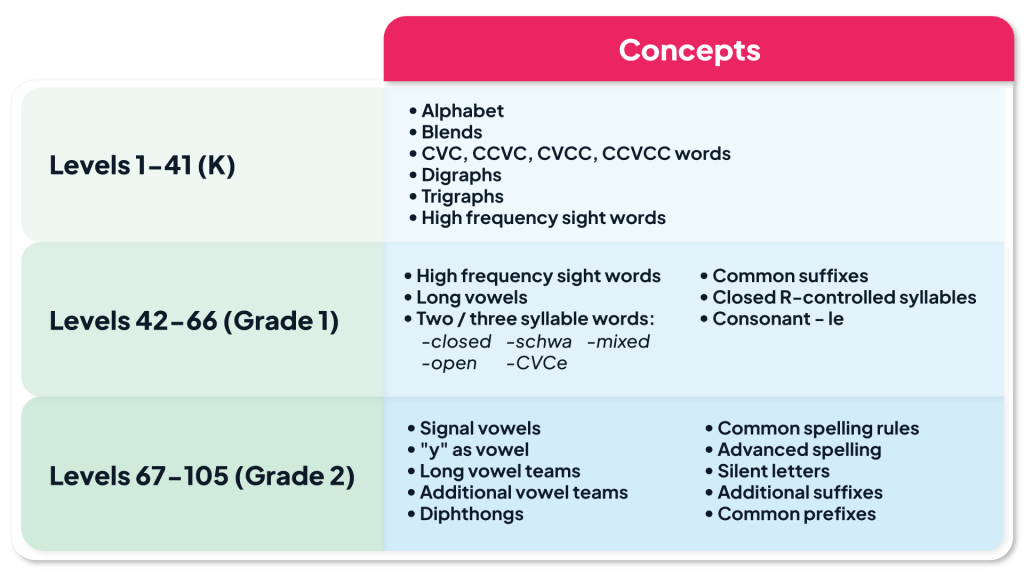
Our Scope and Sequence systematically introduces the most common grapheme-phoneme patterns in the English language, ensuring students build a strong phonics foundation. When paired with explicit instructions from their teacher, students develop the ability to apply phonics skills across different reading and writing tasks. By reinforcing these relationships through repeated exposure and structured practice, phonics knowledge becomes automatic. Our app has activities that promote both decoding via reading and encoding via spelling dictated words using letter tiles.
Research confirms that systematic phonics instruction is significantly more effective than unsystematic or incidental phonics instruction.

3. Fluency
Fluency is the ability to read smoothly, accurately, and with proper expression (prosody). A fluent reader recognizes words automatically, reads at a natural pace, and uses intonation and phrasing to enhance meaning. Fluency is essential for comprehension—without it, students may read too slowly and lose meaning or too quickly without proper understanding.
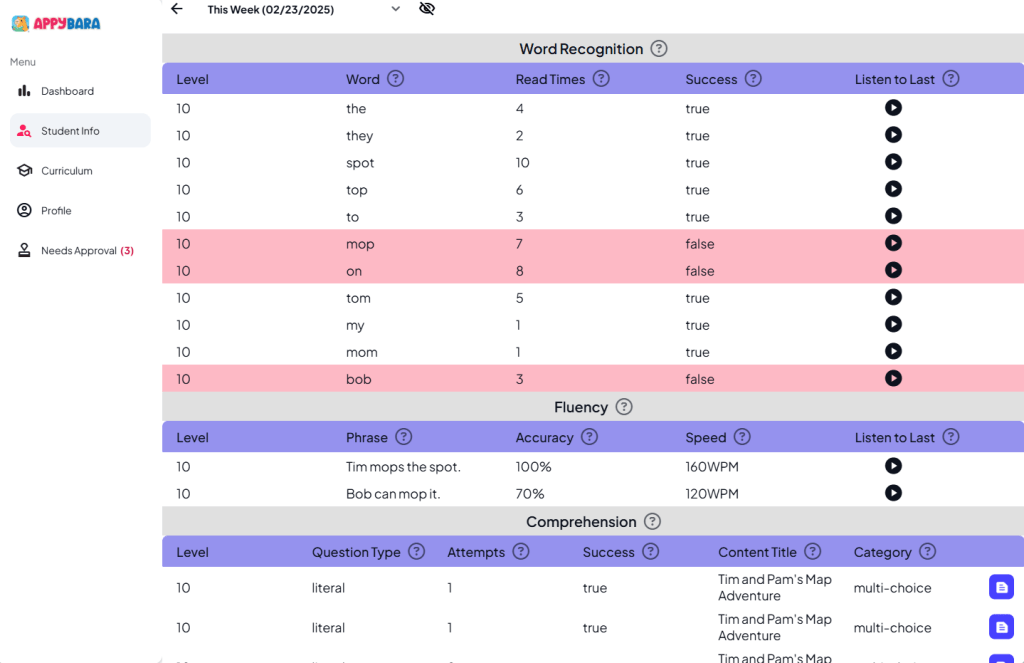
Our app helps students develop and track fluency through built-in tools in every story activity. As students read, their words per minute (WPM) and accuracy are measured and automatically sent to their teacher for monitoring. To support expressive reading, students can listen to a modeled narration with synchronized word highlighting. They can then practice reading aloud and receive immediate feedback on accuracy.
Research shows that fluency improves through modeled reading, repeated practice, and real-time feedback (Rasinski, 2003). By combining these methods, our app helps students develop automaticity and expressive reading skills, leading to better comprehension and overall reading proficiency.
4. Vocabulary
Vocabulary refers to the words a person knows and understands. In reading, it includes both oral vocabulary (words we recognize and use in speech) and print vocabulary (words we recognize and use in reading and writing).
Our app consistently and systematically introduces new words at the appropriate time according to our Scope and Sequence. Students are able to tap any word that appears in a story to bring up an interactive dictionary where they explicitly learn its meaning via the following way:
- a. Listen to how the word is pronounced.
- b. Learn how each phoneme or syllable of the word is pronounced.
- c. Read and listen to a definition of the word for explicit instruction.
- d. ELL students can read and listen to the word translated into 18 different languages.
- e. Use the word in a sentence via speech or typing to promote deep processing.
Additionally, words from previous levels in Our Scope and Sequence reappear in later levels, promoting repeated exposure and reinforcement.
Research supports explicit, systematic vocabulary instruction as essential for literacy development (Beck et al., 2013). Effective vocabulary learning involves active engagement, repeated encounters, and contextual usage, all of which are embedded in our app. Providing interactive, multimodal experiences ensures students retain and apply new words in meaningful ways.


5. Comprehension
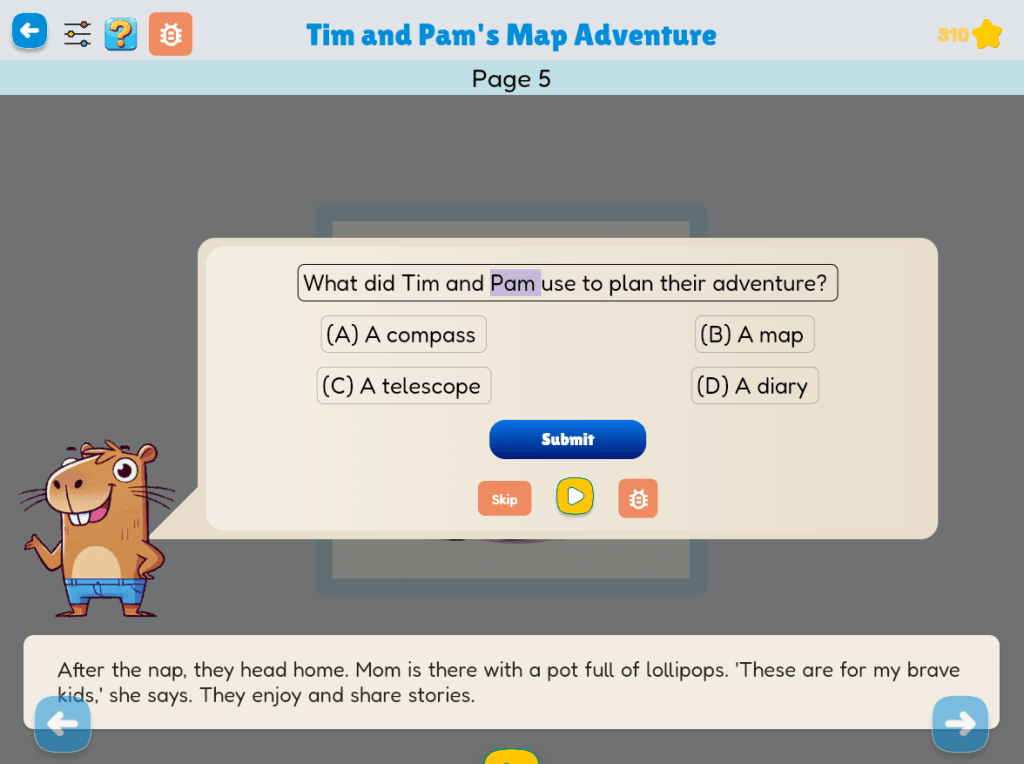
We provide a number of activities designed to assess and improve comprehension. Our reading comprehension tests at the end of stories use different formats such as multiple-choice, open-response, with explicit and inference type questions. Our Curiosity activity intrinsically motivates students to improve their comprehension by presenting text on topics of their choice, at their reading level. Our Draw Stories activity promotes multisensory learning pathways by asking students to illustrate passages, and providing real-time feedback on how well their drawing represents the passage.
Reading comprehension is an interactive process involving the reader, the text, and the activity (Snow, 2002). Research supports varied assessments, intrinsic motivation, and multisensory engagement as key strategies for improving comprehension.

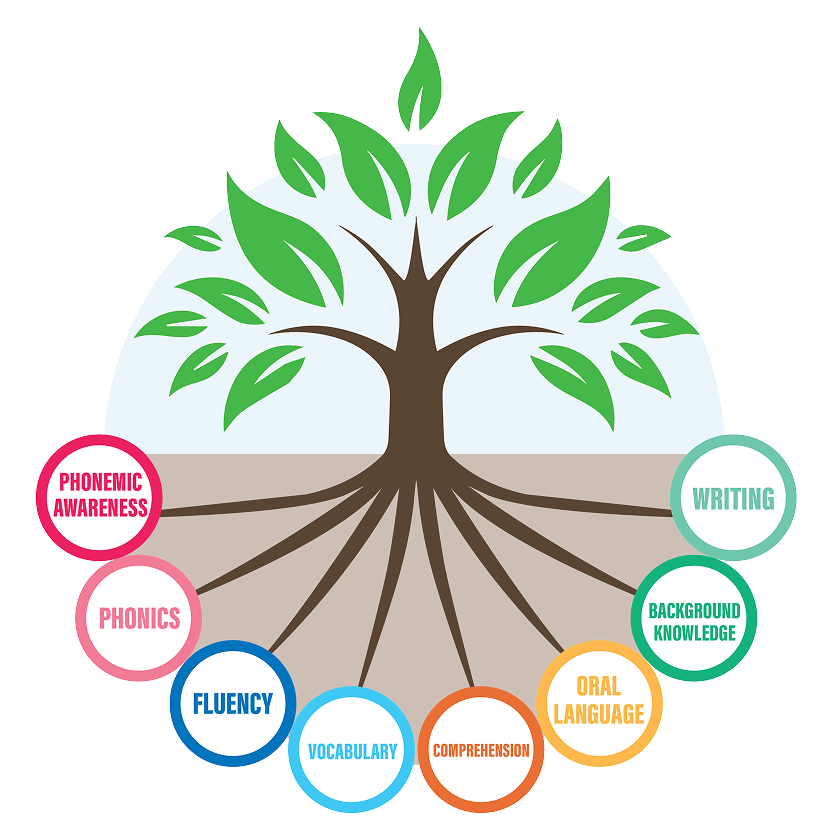
While the National Reading Panel’s five pillars—Phonemic Awareness, Phonics, Fluency, Vocabulary, and Comprehension—remain essential, emerging research highlights oral language, background knowledge, and writing as additional critical components of reading development. Studies show that these skills significantly impact literacy growth, reinforcing the need for a more comprehensive approach. Here’s how Appybara integrates and supports the development of these key components.

6. Oral Language
Oral language involves both learning to talk and learning through talk—a foundational skill that supports reading and overall literacy development. Research shows that oral language skills—including vocabulary, grammar, syntax, and listening comprehension—are key predictors of reading success (NICHD, 2005; Scarborough, 2001).
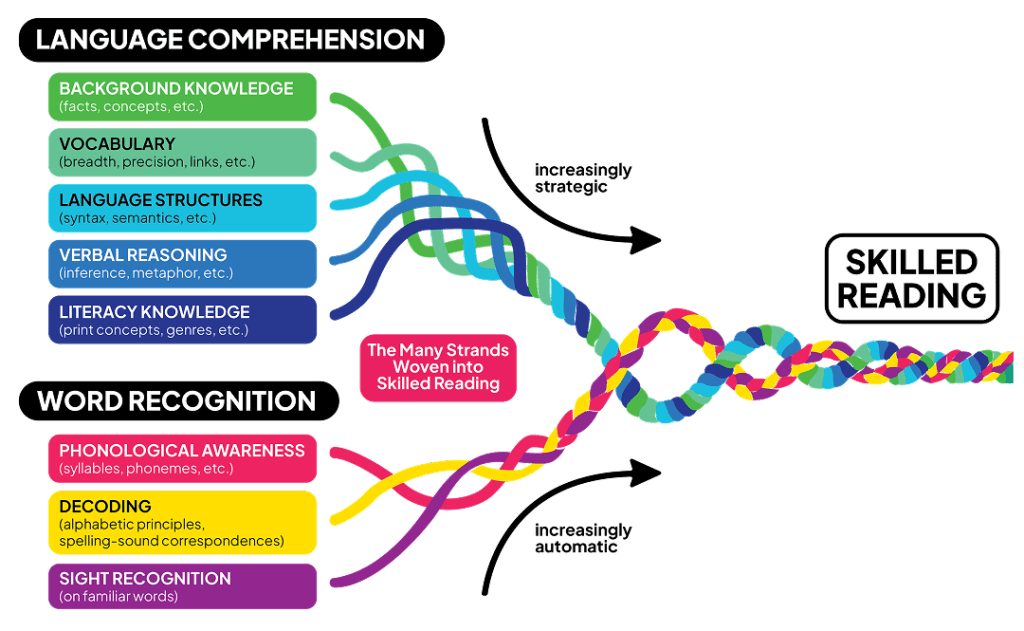
Our app incorporates multiple activities that promote oral language development. All text within the app can be narrated aloud, reinforcing listening comprehension, a skill explicitly recognized in Scarborough’s Reading Rope as a critical component of skilled reading (Scarborough, 2001). Additionally, students can engage in speech-based interactions, using oral responses in activities such as applying new vocabulary from the dictionary or engaging in AI-driven conversations in the Curiosity feature. These interactive experiences ensure that oral language is actively practiced, reinforced, and applied in meaningful ways.
We believe that oral language is not only vital for reading development but will become an increasingly essential skill in the future. As technology evolves, spoken natural language interactions will become more prevalent in daily life and the workplace, making strong oral communication skills more important than ever.

7. Background Knowledge
Background knowledge refers to the student’s understanding of the world, which aids in making sense of new information. In reading, it allows students to make inferences and comprehend texts more deeply. Studies have shown that students with extensive background knowledge in a subject area exhibit significantly better reading comprehension (Hirsch, 2003; Cervetti, Jaynes, & Hiebert, 2009).

We continuously build and strengthen background knowledge through the Curiosity activity, which allows students to learn about any age-appropriate topic they are interested in via conversation with AI, aided by illustrations. At the end of each conversation, they are prompted to learn more about related topics, aiding in semantic mapping and conceptual understanding. Additionally, students can tap any word within the conversation to access our mini-dictionary, helping them deepen their understanding of key vocabulary within context. We also offer nonfictions, which are 90-100% decodable and strengthen their knowledge about a variety of topics.
By integrating interactive topic exploration, AI-driven discussions, and semantic mapping, our app ensures that students continuously expand their background knowledge, setting them up for better comprehension and academic success.

8. Writing
Writing is a crucial component of reading development, acting as a reciprocal process that reinforces comprehension, retention, and critical thinking. Research shows that writing engages brain regions responsible for language processing and comprehension, strengthening the neural networks involved in reading (Hickok & Poeppel, 2007).
While our app primarily focuses on developing direct reading skills, it also integrates writing-based comprehension practice. Our open-response reading comprehension questions allow students to engage with texts beyond multiple-choice answers, fostering deeper understanding and synthesis of ideas. In earlier-level stories, students respond with short answers, while at higher levels, they are prompted to write longer responses that require text analysis and reflection. A meta-analysis by Graham and Hebert (2011) found that writing about texts significantly improves comprehension, retention, and critical thinking, reinforcing its role in literacy development.

Early Intervention and Ongoing Assessment
Research shows that early intervention and continuous assessment are critical for preventing long-term reading difficulties and ensuring sustained literacy growth (Snow et al., 1998; National Reading Panel, 2000). Early, structured support helps struggling readers develop foundational skills before gaps widen, while ongoing assessment allows educators to adjust instruction based on real-time student needs (Torgesen, 2004). Regular assessments provide valuable insights, allowing for personalized instruction that meets each student’s unique learning needs (Fuchs & Fuchs, 2006).
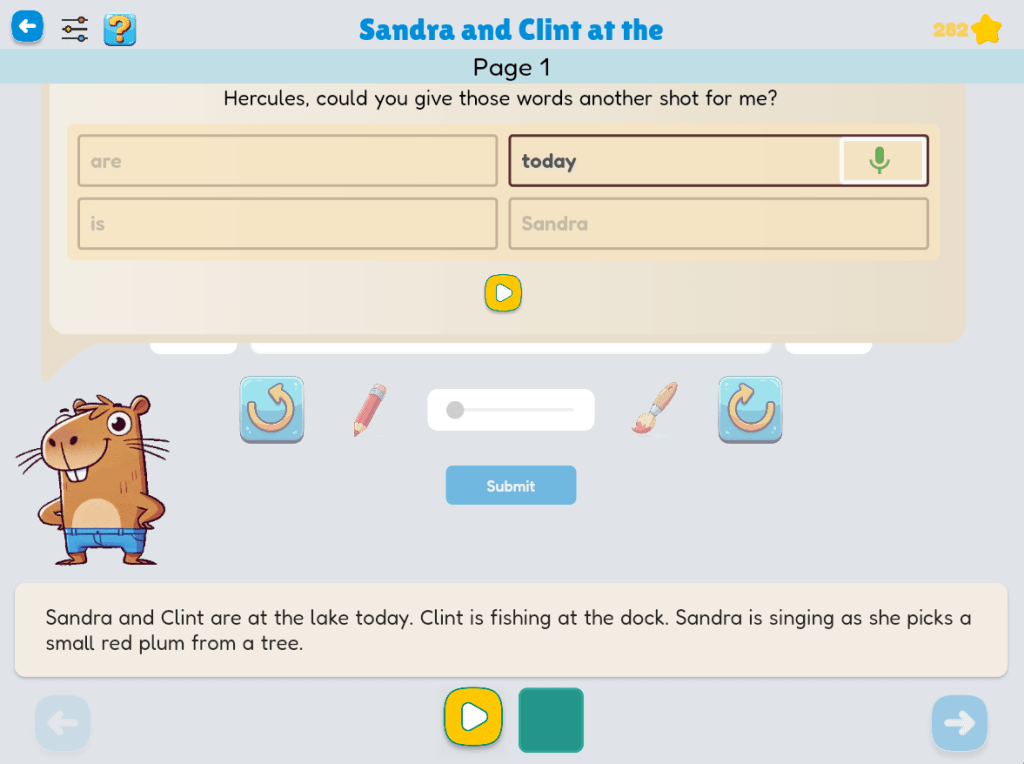
Our app supports this by assessing and tracking key reading skills continuously, ensuring that students master foundational skills before progressing. Key assessments include:
- Decoding– Students read individual words from stories, and their accuracy is assessed.
- Encoding– Students spell words using letter tiles based on dictation exercises.
- Fluency– Students are evaluated on reading speed (WPM) and accuracy while reading passages.
- Comprehension- Students complete various activities, such as answering comprehension questions and illustrating passages to demonstrate understanding.

Assessment results are summarized and presented to teachers, who review student progress to provide targeted instruction. Students only advance to the next level in our Scope and Sequence once their teacher approves, ensuring that new concepts are introduced only when prerequisite skills are mastered. By integrating ongoing assessment with systematic instruction, our app empowers educators to provide timely interventions, ensuring all students build strong literacy skills.



References
Beck, Isabel L., Margaret G. McKeown, and Linda Kucan. 2013. Bringing Words to Life: Robust Vocabulary Instruction. N.p.: Guilford Publications.
Ehri, L. C., S. R. Nunes, and D. M. Willows. 2001. “Systematic phonics instruction helps students learn to read: Evidence from the National Reading Panel’s meta-analysis.” Review of Educational
Research 71 (3): 393-447. https://psycnet.apa.org/record/2002-18026-002.
Fletcher, Jack M., G. R. Lyon, Lynn S. Fuchs, and Marcia A. Barnes. 2018. Learning Disabilities: From Identification to Intervention. N.p.: Guilford Publications.
Moats, Louisa C. 2020. “Teaching Reading Is Rocket Science.” American Federation of Teachers.
https://www.aft.org/ae/summer2020/moats.
National Reading Panel. (2000). Teaching Children to Read: An Evidence-Based Assessment of the Scientific Research Literature on Reading and Its Implications for Reading Instruction.
Washington, DC: National Institute of Child Health and Human Development.
Rasinski, Timothy V. 2004. Assessing Reading Fluency.
Snow, Catherine. 2002. Reading for Understanding: Toward an R&D Program in Reading Comprehension. N.p.: RAND Corporation.
Snow, C. E., Burns, M. S., & Griffin, P. (Eds.). (1998). Preventing Reading Difficulties in Young Children. Washington, DC: National Academy Press.
Torgesen, J. K. (2004). Preventing Early Reading Failure—and Its Devastating Downward Spiral—by Ensuring the Availability of Effective Early Intervention. American Educator, 28(3), 6-19.
Fuchs, L. S., & Fuchs, D. (2006). Introduction to Response to Intervention: What, Why, and How Valid Is It? Reading Research Quarterly, 41(1), 93-99.
NICHD Early Child Care Research Network. (2005). Pathways to reading: The role of oral language in the transition to reading. Developmental Psychology, 41(2), 428–442.
Scarborough, H. S. (2001). Connecting early language and literacy to later reading (dis)abilities: Evidence, theory, and practice. In S. B. Neuman & D. K. Dickinson (Eds.), Handbook of Early Literacy Research (Vol. 1, pp. 97–110). New York, NY: Guilford Press.
Hirsch, E. D. (2003). Reading Comprehension Requires Knowledge—of Words and the World: Scientific Insights into the Fourth-Grade Slump and the Nation’s Stagnant Comprehension Scores.
American Educator, 27(1), 10–29.
Cervetti, G. N., Jaynes, C. A., & Hiebert, E. H. (2009). Increasing Opportunities to Acquire Knowledge Through Reading. In E. H. Hiebert (Ed.), Reading More, Reading Better: Solving Problems in the Teaching of Literacy (pp. 79–100). New York, NY: Guilford Press.
Hickok, G., & Poeppel, D. (2007). The cortical organization of speech processing. Nature Reviews Neuroscience, 8(5), 393–402.
Graham, S., & Hebert, M. A. (2010). Writing to Read: Evidence for How Writing Can Improve Reading. A Carnegie Corporation Time to Act Report. Washington, DC: Alliance for Excellent Education.
National Center for Education Statistics. (2022). NAEP Reading: Reading Highlights 2022. U.S. Department of Education.
Moats, L. C. (2020). Teaching Reading Is Rocket Science. American Federation of Teachers.
Hernandez, D. J. (2011). Double Jeopardy: How Third-Grade Reading Skills and Poverty Influence High School Graduation. The Annie E. Casey Foundation.
Cutler, D. M., & Lleras-Muney, A. (2010). Understanding Differences in Health Behaviors by Education. Journal of Health Economics, 29(1), 1-28.
Get Started Today
We are now taking applications to work with a limited number of students and teachers.